
Overview of Enterprise Resource Planning (ERP)
A potent software program called enterprise resource planning (ERP) unifies disparate business operations onto a single platform. ERP increases data integrity and operational efficiency by combining departments like finance, HR, supply chain, and customer relationship management. Real-time data availability, better decision-making, and faster workflows are advantageous to businesses. Enterprise resource planning (ERP) systems can develop and adapt to changing requirements because they are scalable.
ERP sticks out as a crucial instrument for maximising performance and attaining long-term success as firms embrace digital solutions more and more. ERP solutions, whether on-premises or cloud-based, provide the functionality and flexibility required to succeed in the current competitive environment.
Enterprise Resource Planning (ERP): what is it?
An integrated suite of programs called ERP (Enterprise Resource Planning) software is used to automate and manage key corporate operations. By combining operations like supply chain, finance, HR, and CRM into one system, it improves data accuracy and efficiency. ERP software is crucial for contemporary business administration since it streamlines processes, enhances decision-making, and offers real-time information.
How does an ERP Software operate?
ERP software enables smooth data transfer across departments by combining multiple corporate operations into a single, integrated system. It ensures accuracy and real-time data access by storing data in a central database.
Finance, HR, supply chain, and CRM modules streamline communication and automate procedures. These modules are accessed by users through a single interface, which improves teamwork, eliminates manual duties, and offers thorough analytics for well-informed choices and effective operations.
Key components of ERP software that improve business operations
Together, these characteristics give companies the ability to improve customer satisfaction, streamline processes, allocate resources optimally, and experience sustained growth in cutthroat marketplaces.
- Integration: ERP improves organisational effectiveness and data coherence by combining disparate business activities into a unified system.
- Automation: ERP minimises human error and workload by automating routine operations like reporting and billing.
- Real-Time Data: Having quick access to up-to-date information facilitates quick decisions, which improves responsiveness and strategic planning.
- Financial Management: Contains all-inclusive planning, accounting, and financial reporting capabilities to guarantee compliance and transparency with the law.
- Supply chain management: optimises resource allocation and boosts operational efficiency by overseeing the full supply chain process, from inventory control to procurement and shipping.
- CRM (customer relationship management): Through individualised care and efficient communication, customer relationship management (CRM) improves customer interactions and sales procedures, boosting customer satisfaction and retention.
- HRM (human resources management): Promotes employee engagement and productivity by streamlining HR procedures including payroll, hiring, and performance management.
- Reporting and Analytics: Provides sophisticated tools for producing comprehensive reports and analysing data, offering useful insights for well-informed choices and calculated actions.
What are the types of ERP Softwares?
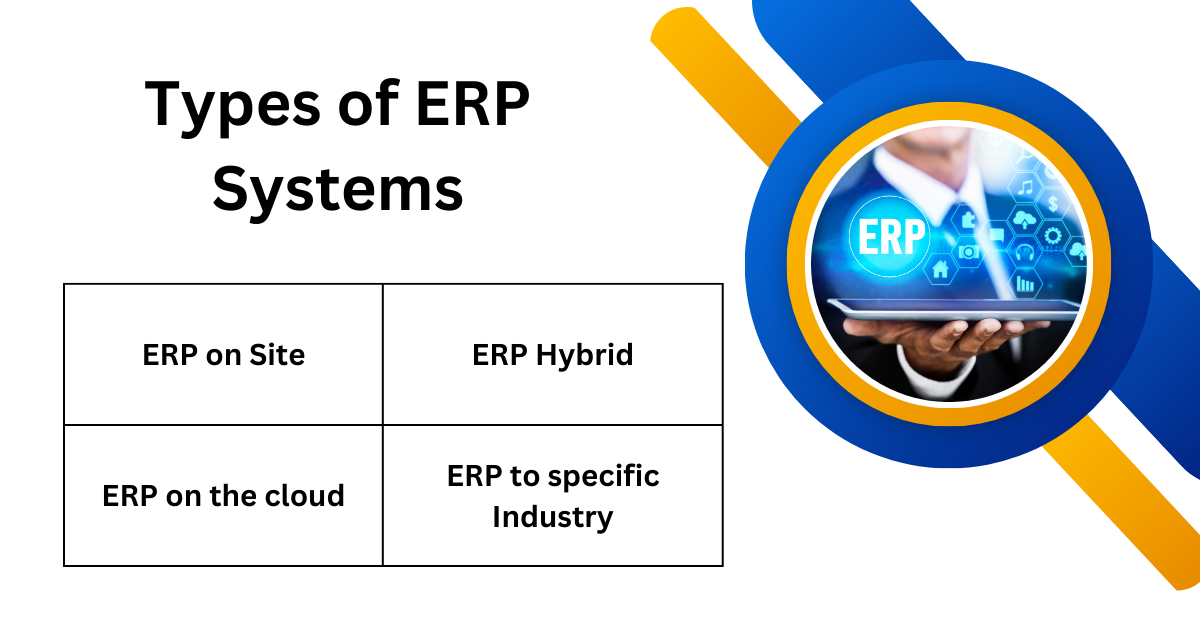
ERP software can be categorised into several types based on deployment and functionality. Here are the main types:
- ERP on-site
With on-premise ERP software, an organisation has complete control over its system and data since it is deployed straight onto its servers and hardware. Businesses can greatly customise the ERP system using this deployment strategy, making it fit certain operational needs and industry norms.
But in order to maintain, upgrade, and debug on-premise ERP, dedicated internal IT staff is usually required. On-premise ERP is the solution of choice for businesses looking for strong control and customised solutions for their business processes, even with the requirement for internal administration since it provides unmatched control and customization capabilities.
- ERP on the Cloud
Businesses can use cloud-based ERP software through the internet, which is hosted on the vendor’s servers and provides flexibility. Scalability is one of its main benefits, enabling organisations to develop without being constrained by physical infrastructure as their activities do.
Additionally, cloud-based ERP encourages cost-effectiveness by doing away with upfront hardware investments in favour of subscription-based pricing schemes that disburse expenses over time.
- ERP Hybrid
By combining the advantages of on-premise and cloud-based systems, hybrid ERP implementation gives companies a flexible way to manage their ERP solutions. The ability to select where to install various modules according to certain company needs and preferences is made possible by this hybrid paradigm.
It makes it easier to move from on-premise to cloud settings gradually, giving businesses the freedom to adopt cloud capabilities at their own speed without sacrificing control over vital information and processes.
This method offers a practical alternative for companies looking to optimise their ERP infrastructure in accordance with changing requirements and technological improvements by striking a balance between cost-effectiveness and the capacity to maintain control over sensitive data.
ERP Specific to Industry
How ERP Software Helps Your Company
ERP (Enterprise Resource Planning) software implementation has many benefits that go beyond operational effectiveness:
- Streamlined Operations: By integrating essential corporate activities, enterprise resource planning (ERP) lowers duplication and boosts productivity.
- Improved Decision-Making: Having access to real-time data facilitates informed decision-making, which improves resource allocation and strategic planning.
- Better Customer Relations: CRM components in ERP improve communication with customers, which raises satisfaction and loyalty.
- Scalability: ERP systems expand with your company, adapting to meet the demands of more users and more data.
- Cost Efficiency: ERP reduces operating expenses and increases overall profitability by automating operations and minimizing manual errors.
- Security: ERP systems mitigate the risks associated with data breaches by ensuring regulatory compliance and data security.
Enterprise Resource Planning (ERP) Software Development at Cosmonaut Technologies
Cosmonaut Technologies excels in crafting enterprise solutions across diverse industries, leveraging over a decade of IT infrastructure expertise. Specialising in bespoke enterprise resource planning (ERP) software development, we tailor solutions to meet industry-specific requirements. Whether your business focuses on product sales or service delivery, our ERP solutions streamline manufacturing, supply chain, and distribution for product-centric firms, while optimising service level agreements, field services, and sales operations for service-oriented organisations. Contact us today to explore how our robust ERP solutions can enhance efficiency and automate workflows tailored to your industry needs.
Conclusion
ERP software improves productivity and data quality by integrating key corporate activities including supply chain, finance, HR, and CRM. It provides alternatives for on-premise, cloud-based, or hybrid implementation, giving users flexibility. ERP encourages software development and innovation while improving scalability, regulatory compliance, and customer interactions.